The modern terrorist threat became one of the most important problems of global security and in now day’s it is obvious that terrorism is very useful leverage in geopolitics. Leverage that can be afford only by “big players” of international relations, such as states, big companies and corporations. Terrorist acts, of course, are cheaper than war as itself, but they are still expensive for “simple” people, who are disagreeing with same points of pursued policy. This “disagreeing” can be provide only if there are great economical and ideological possibilities. Here will be briefly examined such economical possibilities and prognoses if this possibilities will be cut.
“Oil money” and specific external policy
It is the unquestionable fact that modern underdeveloped countries such as Russia, Saudi Arabia, Iraq, Kuwait and others, base their economics on the export of raw materials, particularly oil. Having oil based economics, governments can provide their political, social, economical policy. This is the main source to get money to maintain of the state’s viability. For example, Russia, besides its interior policy that is based on raw materials, has built relations with Chechen Republic on money received from oil and gas exports. In other words, “oil money” are using to resolve interior problems, buy a loyalty of same quasi-government formation (such as foregoing Chechen Republic), and, of course, as will it be shown below, to pursue government’s specific foreign policy course.
By specific foreign policy course I implied interference in the other countries’ policy. There are a few countries that directly or indirectly support the idea of Islamic fundamentalism (or the idea of True Islam) spread in the world and particularly in Central Asia. Some scholars mark out Saudi Arabia as a country supporting terrorism.
“The line between the barrel and the bomb is clear. It is oil wealth that enables dictatorial regimes to sustain themselves, resisting openness, progress and power sharing. Some semi-feudal royal families in the Gulf buy their legitimacy from the Muslim religious establishment. This establishment uses oil money to globally propagate hostility to the West, modernity, non-Muslims, and women.
This trend is likely to continue. Both the International Energy Agency and the Energy Information Agency of the U.S. Department of Energy currently project a steady increase in world demand for oil through at least 2020. This means further enrichment of the oil-producing countries and continued access of terrorist groups to a viable financial network which allow then remain a lethal threat to the U.S. and its allies”.
“Oil money” and Saudi Arabia
Saudi Arabia is a Sunni country funded by Wahabbists since the18th century. Many of the modern Sunni terrorist organizations exist for the most part on “oil money” that they receive from different NGOs and individual donors. It’s important to know that of the19 hijackers who organized the 9/11 attack 15 were from Saudi Arabia. Also this country supports the fundamentalists with the literature and other ideological tools.
“According to a 2009 U.S. State Department communication by Hillary Clinton, United States Secretary of State, (disclosed as part of the Wikileaks U.S. 'cables leaks' controversy in 2010) "donors in Saudi Arabia constitute the most significant source of funding to Sunni terrorist groups worldwide". Part of this funding arises through the zakat (or religious tax) required to be paid by all Saudis to charities, and amounting to at least 2.5 percent of their income. Although many charities are genuine, others, it is alleged, serve as fronts for money laundering and terrorist financing operations. While many Saudis contribute to those charities in good faith believing their money goes toward good causes, it has been alleged that others know full well the terrorist purposes to which their money will be applied.”
Moreover, modern sociologies and historians define the oil industry to be one of the causes that gave birth to the modern terrorism phenomenon, because it provided additional money to the spread of Wahhabi ideology It’s obvious that Saudi Arabia is a Wahhabi made country, and same elite from this country interested in spread of this ideology. “Saudi Arabia has an oil-based economy with strong government control over major economic activities. Saudi Arabia possesses 25% of the world's proven petroleum reserves... The petroleum sector accounts for roughly 45% of budget revenues, 55% of GDP, and 90% of export earnings”.  About the examined theme can also be found other opinion. As example, blogger Bruce Everett in his post wrote: “If oil money were the primary determinant of terrorism, we would expect to see some correlation between oil prices and terrorist activity. We don’t. The price of crude oil was $16 per barrel when the World Trade center was first attacked in 1993, $21 when the Khobar Towers facility was bombed in 1996, $11 when the East African embassies were bombed in 1998, $27 when the USS Cole was attacked and $24 on 9/11. The price reached $140 per barrel in 2008 and is now about $80, yet we have seen no significant increase in terrorist activity since 9/11”. This is true, during modern anti-U.S. terrorist activities there has been no correlation between oil prices and terrorist activity. But it’s important to say that terrorist activity isn’t only a terrorist act as a method. Under terrorist activity should be implied the spread of ideology in a proper region. In this respect, of course, there isn’t this kind of correlation but there is sufficient prosperous spread of Wahhabi ideology in the Central Asia region. Now we can talk only about one country, with Wahhabi system of government – Tajikistan, but in near future the situation has all possibilities to be changed in the bad way.
As a matter of fact, the situation around modern Wahhabi ideology is very particular. In the history of terrorism there are many examples when organizations divided into two parts – “radical parties”, that using violence, and “political parties”, that using non violence methodology, and only in their statements admit radical ideas. “Narodnaya Volea” in Russia, the IRA in Ireland and many others are examples. The same things happen with Islamic fundamentalism. In other words, two different types of organizations existing, first one, like Al-Qaida, are well-known for their acts of terrorism. And the second one, for example, Hizb ut-Tahrir, are working to maintain their ‘unblemished’ reputation: they don’t use violence openly and trying to enter in political life of the country where it is existing.
Some prognosis for Central Asia region
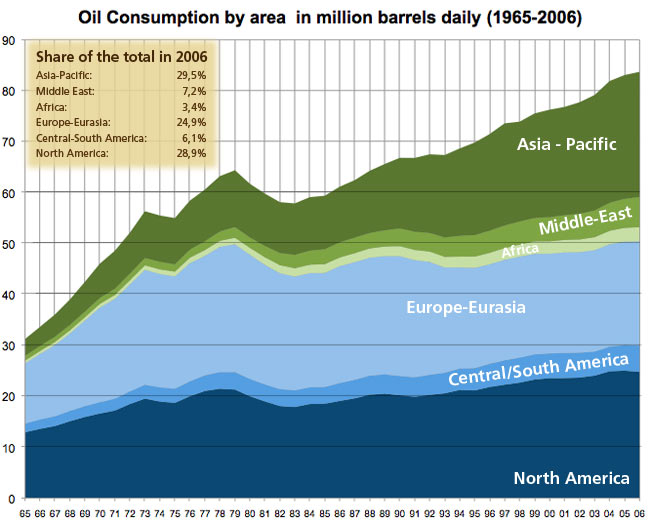
In this work will be examined the consequences of the oil consumption decreases possibilities. Let’s accept the situation when oil extraction falls and the prices rise. Of course, this decreasing will be gradual, and it won’t happen in the near future. As we can see on the image above (“oil consumption” image), the oil reserves are still big, but in the not-so-distant future the world’s economy may start feeling a shortage of the oil. The main reasons are that the increase in the world’s oil consumption, and, of course, appearance of same environmental problems which are caused by carbonic acid and other dangers.
The main and most important fact is that the idea will not die even if it gets into difficult conditions – for example, Nazi ideology, even defeated, exists in nowadays and can be seen in different variations. The same will happen with Wahhabi ideology of ‘True Islam’ – it won’t die if support decreases. The reduction in sponsoring from “oil money” will show the scholars only other ways of self finance. It will reflect only on Central Asia, Middle East, and other poor regions. I think that it won't reflect on Western countries because many ‘terrorist’ organizations already are self-financed. It is induced basically by difference in socioeconomic environment: Islam’s clientelist economies and Western market economies. (For more details I strongly recommend the article “Market Civilization and Its Clash with Terror” by Michael Mousseau).
One more question that can be examined here is what resources can undertake the “oil money” function in Central Asia region. The Central Asia’s courtiers in most cases are agricultural courtiers with poor industry. Therefore the resources have to be connected with agriculture and some services.
Among resources that can replace income from the “oil money” the following can be marked out:
o Water Resources: In the near future the Central Asia region will encounter water shortages, and of course, this may influence the stability of the region in general. Whoever controls water resources controls the whole region. Now the situation doesn’t inspire much optimism, in addition to water consumption increase, as was told earlier, in Central Asia already exists a country with Wahhabi system of government - Tajikistan. It controls 51.5% of water resources in the Central Asia region. In the future this resource, which is so important for the living, has all possibilities to become one of the main reasons to start a war. o Drug traffic: there is one more important resource that can help overcome crisis when oil extraction will decrease. It’s obvious that after the invasion in Afghanistan (2001) the drug production increased immensely. The officials say that this happened because there is only one agricultural product that can provide the same living level for local Afghani residents. This culture is poppy, which is the main source of heroin. It’s important to mention that Karzay’s government with U.N. tries to elaborate a strategy that “will include targeted programmes of agricultural development and the reduction of poppy cultivation.” Afghan heroin is an exported material – from Afghanistan it is transported via Tajikistan to Russia and then spread over the country or distributed all over the world. Also, all these financial cuts will lead to fights between different organizations for resources. Based on project management and fundraising, it is known that one of the main determining factors of continue sponsoring is the visible result of activity. These results in their turn will lead to increase in the level of violence.
Moreover, since the Soviet Union collapse, this region has been unstable from both an economic and political point of view. The long unstable situation in a state influences social culture and decision making habits. The higher the social level is, the more humane and compromising the solution will be.
Also we shouldn’t underestimate WMD usage. This is very expansive weapon, but by using it can be resolve many goals such as international effect.
This is the main possibilities that may happen if the oil extraction decreases. Here should be remained, that “the oil and mining industries have been also associated with violent protest in many parts of the world. With respect to oil, one analyst recently claimed that: 'From Nigeria and Venezuela to Indonesia and Algeria, riots, conflict and outright civil war threaten the populations of OPEC countries”. In this respect, we, firstly, have to accept that “oil money” from Saudi Arabia, and other oil based economic countries, can support Wahhaby ideology of True Islam spread. Secondly, the problem connected with decrease of oil consumption that no doubt will appear in future will influence on Central Asia security. Thirdly, reduce of terrorist organization financing will lead to search of the “new money” source. In turn this may reflect on increase of violence in this region as fighting for reserves.
Financing Terrorists by Bruce Everett