Showing posts with label Libya. Show all posts

Thursday, 28 April 2011

A Few Words on the ‘Great Man-made River’


A Few Words on the ‘Great Man-made River’

The Libyan war, which started two months ago, is still riveting world’s attention; till now Internet space is excited about nuances and process of this war. Speaking candidly, about month ago I also couldn’t hold myself from making an attempt to figure out possible consequences of this war event; today, I think, it’s time to write something about the Kaddafi regime which is already Libyan past.
Lyrical digression or thoughts about Libya: Unfortunately, we all became dependant on Mass Media and Libya’s war is not exclusion: the long confrontation between this country and western world made specific image of this country in the world. However, we should give the due to Gaddafi regime: “It is one of the few countries where the natural resources were used directly for increasing people's living standard without encumbering the country with debts or loans - in spite of the indisputable political 
negatives Libya has the highest Human Development Index  (HDI=0.755 as of 2010, 53rd place in the world, evaluated by the United Nations based on life expectancy, education and gross domestic product per capita) among all African countries, even higher than some countries within EU and NATO (Bulgaria: 0.743, Turkey: 0.679 as of 2010). That's something undoubtedly worth paying an attention, regardless of all the objections which the western society may have to the specific form of socialism ruling in this Mediterranean country.[1]” But, unfortunately, all this numbers are ignored during the description of Socialist People’s Libyan Arab Jamahiriya. I think, it’s time to see some really interesting and important steps that Libya made before the revolution of 2011, and in this post I will tell a few words about The Great Man-made River– the eighth world’s wonder as "another miracle in the desert."[2]. Also it “has been described as the "eighth wonder of the world". It carries more than five million cubic metres of water per day across the desert to coastal areas, vastly increasing the amount of arable land. The total cost of the huge project is expected to exceed $25 billion (US).”[3]. The main idea of this post is to point out some economical aspects of the Great Man-made River project; but before this I think it would be better to write some information on history of this project.


History of Saharan water reservoirs

So, speaking in short, Sahara Desert wasn’t area which has only sand with out drop of water. “Remnants of an ancient lake existing there between 750 thousand and 420 thousand years ago were found in south-western part of Libya (Fezzan). Scientists named it Megafezzan - with a surface area of 130 thousand km2 (50,193 sq mi) it is definitely worth of bearing its name (compare with the largest of the Great Lakes - Lake Superior, with the surface of 82,000 km2 [31,700 sq mi]). Local sediments are an extraordinary source of information about the climate changes in Sahara during the last 750 thousand years”[4]. “It is also noteworthy that this water originated mostly from the last ice age (therefore, the term "fossil"), and has accumulated in the reservoirs approximately 1 million - 10 000 years ago, when the climate was generally wet, rich in rainfall, and sufficient for maintaining a complex river system.”[5]
“Geological activity caused the up thrust of mountainous formations (Jabal Nefussa and Jabal Al Akhdar) and the associated downward movement formed natural underground basins. Between 38,000 and 10,000 years ago the climate of North Africa was temperate, during which time there was considerable rainfall in Libya. The excess rainfall infiltrated into porous sandstone and was trapped between layers, forming reservoirs of underground fresh-water.
In Libya there are four major underground basins, these being the Kufra basin, the Sirt basin, the Morzuk basin and the Hamada basin, the first three of which contain combined reserves of 35,000 cubic kilometers of water. These vast reserves offer almost unlimited amounts of water for the Libyan people.”[6]

During the oil-searches in 1960s the water was discovered[7] and about 30 years later The Great Man-Made River Project (GMMR) would be started.

History of the project

Speaking about history of the GMMR Project development can be point out 5 main phases:
http://newsimg.bbc.co.uk/media/images/41462000/gif/_41462932_libya_water3_map416.gif§   First phase of the work began in 1984 in the most rough and arid south-eastern region of Libya, water having been transported from the well fields containing 234 drills through 1,600 km (994 mi) long pipeline into two coastal areas. Two reservoirs have storage capacity of 20 million m3 (706 million cu ft) of water. Transport capacity reaches 2 million m3 (70.6 million cu ft) per day. Power consumption: 65 MW. First water reached its destination in 1990.    
§   Second phase brought the water finally to the Tripoli capital - 1,227 km (762 mi) long pipeline in the western part of the country is capable of transporting 2.5 million m3 (88 million cu ft) of water per day and provides inhabitants with water containing more than twenty times less salt than the previous sources.
§   Third phase extended the first phase pipeline by another 383 kilometers (238 mi) deeper into the desert, where a new well field containing another 300 drills was constructed. Seven new pumping stations transport additional 1.68 million m3 (59.3 million cu ft) of water per day, whilst the whole journey to the final reservoirs takes approximately 9 days.
§   Fourth phase is of a relatively smaller scale, and will transport quarter of million m3 (8.8 million cu ft) of water per day, using 621 kilometers (386 mi) of pipelines (plus 181 km [112 mi] of pipes within the well field itself), four pumping stations and three reservoirs.
§   Fifth phase will be the final one connecting the western and eastern transporting systems. With the pipeline being 190 kilometers (118 mi) long, transporting capacity of 0.98 million m3 (34.6 million cu ft) per day, two pumping stations, power consumption 43.6 MW, and one reservoir, it will be a smaller although important sibling of the preceding phases[8].
Amazing work, wouldn’t you say?!

Problems & Critics of the project
Among welfare fossil water brings some troubles, such as:
Radioactive Worries: the example, The Disi's (Jordan's water reserve) fossil water was recently found to contain 20 times the radiation levels considered safe for drinking. The water is contaminated naturally by sandstone, which has slowly leached radioactive contaminants over the eons[9]. Same worries is about Libyan underground water, however, there is possibility to clean this water through a simple water-softening process, though it does cost money and creates radioactive waste that must be disposed of properly, he noted.
            Ecologists have objections to draining the nonrenewable water resources (counterargument of the Libyan government is both the volume of the reserves - with the current rate the aquifers in Libya itself will sustain for more than one thousand years - as well as uselessness of leaving the water in aquifers, having negligible value if left untouched).
Politicians point out the possible future conflicts among the neighbouring countries due to the reciprocal draining of the aquifers which naturally do not obey the political borders (counterargument of Libya is its panafrican approach and suggested cooperation with the neighbouring countries, which do not use the aquifers yet).
International economists in turn criticize growing crops with water obtained in this way would be more expensive than import of foods from abroad - counterargument is the fact that 30% of water is being used for direct household usage, as well as state-of-the-art methods of economical and effective irrigation and, last but not least, the unique advantage of the food self-sufficiency and stable price of the crops obtained by irrigation employing the man-made river.[10]
So we can see that this project is criticized, but the main point, I think, is that is works and helps people survive in Sahara desert.

Economic and global aspects

Main point of this post is to show what this project was developed for. Here are some words about main goals of the GMMR:
“The Great Man-Made River Project is bringing water to the people and providing water for municipal, industrial and agricultural use. The strategy of the responsible Libyan authority is aimed at increasing both crop and livestock production to a level that achieves the highest possible rate of self-sufficiency and reduces dependence on imports from foreign markets to the lowest possible level. It also aims at increasing the productive capabilities of the labor force and of the capital investments in the sector, and at producing raw materials for food processing industries”[11]. So, the main goal was independency from water and agricultural import.
From my very subjective point of view, economic and global aspects of GMMR project can be divided into two parts:
The aspect number one: As was told already the project cost is $25 billion, and all money was taken only from Libyan funds – rare case in modern globalized world. The world investment practice became very popular and it works in liberal countries, but this practice doesn’t work if we are speaking about authoritarian-socialist state as was Libya during Gaddafi regime. As investment implies partnership in a possession, but Libyan government couldn’t make such step towards west.
Kaddafi regime in Libya is very interesting case: small country with a big independent income from oil industry, socialist policy and etc. And concerning Libya this project could be considered as an uncommon anti-globalization step. Globalization is a modern phenomenon of economic, cultural and other integrations, but Libya’s example is rather ‘worth exclusion’: it can show to others that countries with close economy can develop something without international help.
And we can see the reaction of this in western countries. The GMMR is world well-known project, but, unfortunately, we can’t find much objective information about it in western mass media, as the project shows possibilities of anti-globalization movements. In one Libyan article we can find such words: “The West refuses to recognize that a small country, with a population no more than four million, can construct anything so large without borrowing a single cent from the international banks.”[12]
The aspect number two: economical possibilities that can provide the GMMR are a big blow to a water business. “The cost of one cubic meter of water [received from the GMMR] equals 35 cents. The cubic meter of desalinized water is $3.75. Scientists estimate the amount of water to be equivalent to the flow of 200 years of water in the Nile River.”[13]
And next:
https://blogger.googleusercontent.com/img/b/R29vZ2xl/AVvXsEjvcrzqKtTEaZHplUjIRonao8Z1exuvgm9GO0tWq38db7K2taSpXRC2vGSi_C4kM5JHvZTQLn09RkY32Q3pFGsVHTn8h5NQqfTB0RKxUCh2Lczp591L4V7MXsbUrXsl4ZDAhdkbqmw8HA3r/s320/cost_comparing.gif“Amount of water in cubic meters which could be provided for one Libyan dinar, based on scientific research. Studies proved the man-made river being the most economic approach, which provides more than ten times of water for one dinar compared to various alternative technologies (e.g., undersea pipeline from Southern Europe, transport by water tankers, sea water desalination etc).[14]”
As you can see on a picture with ‘drops’ for one Libyan dinar people can buy 9m3 of water. The independency from import of the water could provide state independency form other word.
I'm interesting what prices will be if somebody privatize this project....


Afterword
            From my point of view this project is one of the best things Gadaffi made form Libya, and we should give him recognition for this contribution in Libyan economic and social life’s change…
“Initially, authorities intended to drill the wells directly in the aquifer areas and thought of creating whole new cities and irrigated agricultural areas there. However, due to the necessity of transferring high numbers of inhabitants and building infrastructure in a poorly accessible terrain this possibility was soon abandoned as being economically unfeasible. Therefore, in concordance with a bit reformulated old Arab saying "If Muhammad will not come to the mountain, then the mountain must go to Muhammad", the project of the man-made river of hitherto unprecedented dimensions was decided to be realized in 1983 in order to bring the fresh water from inside the deep desert to the people at the coast. Nevertheless, it was inevitable to overcome several obstacles -  considerable distance between the aquifers and the coast, rough desert conditions, elevation differences in the terrain, corrosion of the reinforced concrete, and many more”[15].
           
And in the end I want to propose you some image I made few days ago via Google Earth:
1) the year of 1972 and 2004:


 drills


fields

[1] http://www.boinc.sk/clanky/libyas-great-man-made-river
[2] http://www.galenfrysinger.com/man_made_river_libya.htm
[3] http://www.ethiopianreview.com/forum/viewtopic.php?t=27590&p=150954
[4] http://www.boinc.sk/clanky/libyas-great-man-made-river
[5] http://www.boinc.sk/clanky/libyas-great-man-made-river
[6]http://tpartyus2010.ning.com/profiles/blog/show?id=3180617%3ABlogPost%3A71032&commentId=3180617%3AComment%3A70937&xg_source=activity
[7] http://www.americanscientist.org/science/content1/9585
[8] http://www.boinc.sk/clanky/libyas-great-man-made-river
[9] http://www.onepakistan.com/news/local/karachi/43609-Fossil-water-becoming-valuable-fossil-fuel.html
[10] http://www.boinc.sk/clanky/libyas-great-man-made-river
[11] http://www.goumbook.com/4729/libyas-great-man-made-river-project/
[12] http://abundanthope.net/pages/Political_Information_43/Virtually-unknown-in-the-West-Libya-s-water-resources_printer.shtml
[13] http://www.galenfrysinger.com/man_made_river_libya.htm
[14] http://www.boinc.sk/clanky/libyas-great-man-made-river
[15] http://www.boinc.sk/clanky/libyas-great-man-made-river

Saturday, 23 April 2011

Libya: from the political conflict to ethnic one

Libya crisis: Misrata tribes 'may fight rebels'

Tribes loyal to Libyan leader Muammar Gaddafi have said that if the army cannot drive rebels from the besieged port city of Misrata, they will, a senior official says.
Deputy Foreign Minister Khaled Kaim said the army had tried to keep civilian casualties low but the tribes would not show the same restraint.
Colonel Gaddafi's forces have been pounding Misrata for weeks.
Meanwhile, Nato forces carried out more air strikes on the capital, Tripoli.
The Libyan government says three people were killed by the strikes.
Journalists were shown a concrete bunker near Col Gaddafi's Bab al-Azizia compound that received two hits early on Saturday.[1]


Tuesday, 19 April 2011

NATO Secretary General's Press Conference

NATO Secretary General's Press Conference 


Great Video about Great Aspiration!
during the press conference Mr Rasmusen answered on some question about NATO's role in Libyan conflict.
So main objectives in this operation:
Yesterday the NATO foreign minister made clear the three military objectives of our mission in Libya: firstly, an end to all attacks and thread of attacks against civilians. Secondly, that will draw of all receive forces to barracks. Thirdly, an immediate humanitarian access. And we strongly endorsed the call by the contact group for Qaddafi to leave power, So, NATO is absolutely determine to continue its operation for as long as the thread against Libyan civilians and it’s impossible to imagine that this thread disappear when Qaddafi in power.


It was a good final question from Russian journalist:

Mr Rasmusen, the main reason for NATO operation in Libya is protecting civilians, so why NATO doesn’t stand up civilians in Yemen and Syria and don’t you think that the NATO operation creates the situation when authoritarian and not authoritarian regimes are motivated to obtain weapons of muss distraction as guarantee from foreign intervention?

Mr Rasmusen: We have taken action in Libya because the UN Security Council took an historic decision to adopt a resolution that lives up to the responsibility to protect. The responsibility to protect civilians against brutal and systematic attacks from their own government, own regime. And we operate in a co-ordinance with and with in the frame work of that UN Security Council a resolution. The UN Security Council applies to all countries and this resolution also mentions regular organizations like NATO so we feel a responsibility to participate in the implementation of that security come to resolution. This is a reason why we took action in Libya to live up to what the UN Security Council requested. 

I remember my lesson on rhetoric: if you don't know what to answer on the question you've asked, start answer on unimportant and small part in this question, in another words find your way to speak about and make visibility that you are speaking on theme.
So here we can see a good example of such answers: the journalist ask him about "so why NATO doesn’t stand up civilians in Yemen and Syria and don’t you think that the NATO operation creates the situation when authoritarian and not authoritarian regimes are motivated to obtain weapons of muss distraction as guarantee from foreign intervention?" But Mr Rasmusen answers on this "the main reason for NATO operation in Libya is protecting civilians", i understand that this is very complicated question and this situation around Libya can make many consequences in a future, but as for me it is very improperly to make babble on this problem.

Monday, 18 April 2011

possible crisis in EU & NATO

In one previous post of mine I tried to figure out what consequences might be because of the Libyan war; however, I didn't imagine that would such migration crisis in Europe. Moreover, as we can see, this crisis influences on internal EU relations:


Deutsche Welle: "France temporarily stopped a passenger train from neighboring Italy to prevent North African migrants from entering the country on visas issued by Italian authorities. The move highlights a growing row over migration". 

“A group of Italian and French activists on Sunday had planned to board what they dubbed "The Train of Dignity" to accompany migrants with visas into France to protest Europe's measures to shut down its borders despite the Schengen agreement. 

The French authorities said they would allow in only Tunisians with passports and the financial resources to live in France independently.

The Italian newspaper La Repubblica reported that Rome was not demanding a passport before handing out visas and was set to issue about 100 documents a day.” [1]

           
Moreover, in the web can be found more pessimistic ideas, that not only EU can experience some internal crisis, but also image of NATO can really suffer because of this operation:

              "In truth, the Libyan expedition is an Anglo-French project and has been from the beginning. Yet neither Britain nor France wants responsibility for the operation — and neither feels comfortable relying on the other. The French grumble that the American withdrawal has encouraged Moammar Gaddafi; the British think the French might now be distracted by a war in their former colony, Ivory Coast. This failure to cooperate is hardly surprising. This, after all, is the first Anglo-French military operation since the Suez escapade of 1956 — and that one ended rather badly". 
“But if this historically unreliable Anglo-French coalition proves unable to sustain a long operation, what then? There is certainly no European force that can replace it. There isn’t even a European foreign policy: Years of diplomacy, debate and endless national referendums culminated, a couple of years ago, in the selection of two powerless figureheads as Europe’s “president” and “foreign minister.” Attempts to create a united European army have never moved beyond pure symbolism. If Britain and France run out of planes, fuel, money or enthusiasm, it’s over. And NATO — an organization that, I repeat, did not plan for, prepare for or even vote for the Libyan operation — will shoulder most of the blame. The use of NATO’s name, in Libya, is a fiction. But the weakening of NATO’s reputation in Libya’s wake might become horribly real. ”. [2]

Sunday, 17 April 2011

The second chance to resolve the Libyan conflict

"WASHINGTON — The Obama administration has begun seeking a country, most likely in Africa, that might be willing to provide shelter to Col. Muammar el-Qaddafi if he were forced out of Libya, even as a new wave of intelligence reports suggest that no rebel leader has emerged as a credible successor to the Libyan dictator.
The intense search for a country to accept Colonel Qaddafi has been conducted quietly by the United States and its allies, even though the Libyan leader has shown defiance in recent days, declaring that he has no intention of yielding to demands that he leave his country, and intensifying his bombardment of the rebel city of Misurata." [1]

What a great news; however, nobody did say that after his exile he can return back like ... Napoleon returned from Elba with all followed consequences. So there is a little chance for a good and long life somewhere in Africa. :-)


One more thing: “We learned some lessons from Iraq, and one of the biggest is that Libyans have to be responsible for regime change, not us,” one senior administration official said on Saturday. “What we’re simply trying to do is find some peaceful way to organize an exit, if the opportunity arises.” [2]

Good idea, but concerning Libyan war it looks like western policy divided into 2 parts or roles: one for Europe - a brute-force attack, or "physical contact" and other for US - a "good peacemaking policy".
So let's study modern diplomacy on this good example)

Wednesday, 13 April 2011

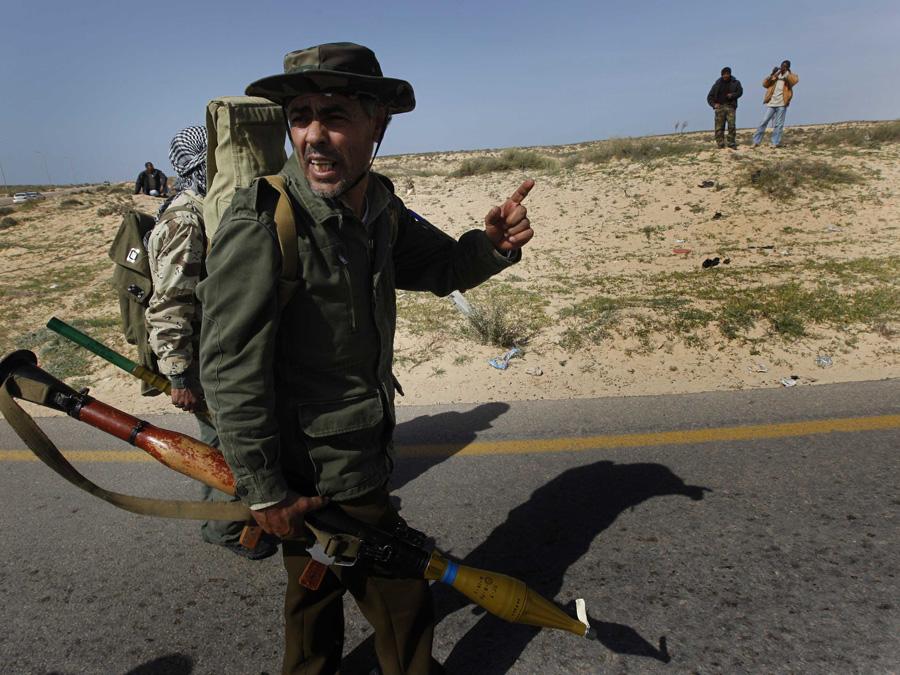
Some Libyan rebel photos

Some Libyan rebel photos:


Among other heroic photos we can find and something like this:


And, of course, they aren't smoking tobacco...

Sources:
http://www.businessinsider.com/libya-rebellion-pictures-2011-3#libyan-rebels-ride-into-battle-at-brega-1
http://publicintelligence.info/libyan-rebel-photos/
http://fishki.net/comment.php?id=86675

Tuesday, 12 April 2011

France: fingers in many African pies

France returned in NATO and wanted to make up leeway?! The Ivory Coast conflict has just resolved with France help:

“Ivory Coast's UN-recognised President, Alassane Ouattara, has urged restraint after the dramatic capture of his rival Laurent Gbagbo”[1].


And exact in this day France's foreign minister made statement where he described dissatisfaction of NATO’s role in Libya:

 “Nato is not doing enough to destroy heavy weaponry used by Muammar Gaddafi's forces in Libya, France's foreign minister has said.
Libyan civilians remain at risk, Alain Juppe said, despite an ongoing bombing campaign now led by Nato.
"Nato must play its role fully. It wanted to take the lead in operations," Mr Juppe said, saying efforts so far were "not enough".[2]”

After failure of [3] African Union's proposal this statement of France's foreign minister shows only the one way out: ground operation.

Moreover, the “kavkazcenter.info” wrote interesting notes about French and other countries’ ground forces in Libya:
“"The Algerian newspaper "Al-Khaber" published a report saying that a French commando unit got lost in the desert region of Al-Hamada Al-Hamra in the south-west part of the country. According to the newspaper, they went there to prevent the flow of weapons, mercenaries and terrorists into Libya. For reasons that are unclear, Paris lost contact with the commandos and asked Algeria to provide air-space and two air force bases in order to search for the special forces soldiers," wrote the Italian newspaper.
"The aforementioned French unit is one of the many units sent by the coalition to assist the rebels. British SAS soldiers, CIA agents and, probably, special forces from Arab countries are active in this theater of war."”[4]
LA Times: “Reporting from Washington— CIA officers are on the ground in Libya, coordinating with rebels and sharing intelligence, U.S. officials say, but the Obama administration has not yet decided whether to take the further step of providing weapons to those trying to oust Moammar Kadafi.”[5]
This war became very expensive for Europe, and the stumbling block isn’t money; the main problem is political benefits, which can reach after Libyan struggle.

So, speaking truly, I’m expecting for the ground operation. Why? There are many voice against such intervention, however they doesn’t relief from the situation: conflict has no evolution nor for rebels neither for Gaddafi forces. I think, that inspired by ‘victory’ in Ivory Coast French’s government might consider that it will be other fast ‘victory’ in Libya, and they want to repeat the same scenario that was in Ivory Coast...


[1] http://www.bbc.co.uk/news/world-africa-13044818
[2] http://www.bbc.co.uk/news/world-13046127
[3] http://english.aljazeera.net/news/africa/2011/04/201141116356323979.html
[4] http://www.kavkazcenter.com/eng/content/2011/04/08/14055.shtml
[5] http://www.latimes.com/news/nationworld/nation/la-fg-cia-libya-20110331,0,4277132.story?track=rss

Saturday, 2 April 2011

Postmodern “Year of Africa”: what should we expect

The year of 2011 has already become a year of great revolutions in Muslim Asia and Africa. Because of its large scale this movement can only be compared with the Year of Africa[1] that was in1960 when many African countries got the independence from colonial powers. In my opinion, all these revolutions are part of postmodern picture of the world, and it can be seen as mixed ideas of pre-democratic societies and contra-reaction against western politics in region. For example, in Libya both Islamist[2] and democratic ideas can be seen among anti-Kaddafi rebels. Both of these forces are hoping to come in power in the fullness of time. And we could see that the aphorism ‘my enemy’s enemy is my friend’ is working very well during Egyptian revolution. That’s why George Soros expressed support for The Muslim Brotherhood during the very beginning of this revolution.
Now, with the Libyan civil war and events in Syria just escalating we can only guess what country will be next in the revolution’s list. But, in my opinion, we should begin thinking about the future of all these countries and the whole region. Here I want to outline some details that drew my attention during all these revolution events in the Muslim Africa and Middle East. The consequences that I want to talk about can be divided into 3 groups: local, regional and global.

Local: There are some possible consequences inside Libya:
Concerning Libya, there is a great possibility for an increase in the level of the various radical movements’ adepts inside the country. After the change of government in the revolutionary way, came a period of transition and it commonly accompanies with a period of instability, which is a good chance for radicalism development.
One of the reasons of the revolution movement in this region was high unemployment level. The economic transformation, after revolution and the hostilities in a country such as Libya might lead to an increasing unemployment level not only there but in countries that are nearby. Almost certainly, in the near future an unemployment problem in countries, which have had a revolution period won’t be resolved. That’s why there is an opinion that radical Islam would have the chance to come in power in case the unemployment problem is not resolved.
Another issue, which is closely connected with the above one, is that there are possibilities for the appearance of many other economical problems after stabilization of political life in this country. It is obvious, that the Muslim traditionalism in economical life can’t provide stabile democratically and liberal reforms. This kind of after transitional period problems can be brought about by, for example, oil industry privatization or other steps of quasi-liberal reforms approaching. This might bring on high level problems that had been resolved during Kaddafi’s regime, as example, water problems. Change of regimes might influence of the water politics in this country; old project can be stopped, but new can be started. So, I think, this can aggravate water problem – export prices for this strategic resource might grow in future and that, of course, will lead to a decreasing in the standard of living[3].

Regional: it also can be proposing some ideas for Muslim Africa and Middle East region:
All kind of transformations in such Muslim courtiers will imply economic, political and, of course, cultural changes. Among the cultural transformations, a progressive shift from traditional to modernized society can be identified. And here we can see really huge problems: are these Muslim countries ready for the changes like this or we are ready to expect from them some radical movements and instability in region.
 There are also possibilities of Muslim countries migration ties break. As we could see in Libya many workers had come from nearby countries, so increasing the level of unemployment in the North African region[4].
One more important consequence is that by this interference in the internal problems of Libya (even if this is a ‘humanitarian intervention’), Western steps shows to some countries in Muslim world that the idea of a government’s sovereignty isn’t yet so untouchable. The operation in Libya can show to other Muslim countries that only one chance to save their sovereignty is a deter factor, as a example, WMD.
Also, today many Western TV channels have been talking for a very long time, that revolution movement in Tunisia, Egypt, Libya and Syria (maybe in near future to this list will be added Algeria) was done with only one purpose: the transformation of authoritarian types of government to democratic societies. However, as Libyan example shows, it isn’t clear until now whom UN and NATO are supporting in this conflict. And I see a very interesting precedent here: very rarely can we see the situation when the U.S. and Europe don’t support rebels as freedom or democracy fighters, but as they are against existing government of Colonel Kaddafi and his regime. Military support is continuing even though many rebels may be Al-Qaida forces and other representatives of radical Islam. Beside this, the expectations of democratic changes in such countries are utopian and very naive, as there are only few countries among Muslim countries which pretend to have success in democracy. Among these countries is Turkey and it made a one-hundred-year-long trip to democracy but still has great problems of democracy adaptation[5].

Global: And in the end, outside Muslim region consequences:
We have already witnessed immigrant crisis that has been developing on Lampedusa Island[6]. Europe can’t save itself from this kind of immigrant crisis in future because of many reasons including the fact that they depend on immigrant labor and, in some ways, well-developed Human Rights politics. As a result Europe will have a high level of terrorism threat in the near future because of immigrants from Muslim countries.
Moreover, nowadays socio-political relations between Muslim and Western countries can’t be called strong. This little Libyan war that is so necessary for France’s president, can lead to a big problems inside French. It will be recalled that about 6 million Muslims are living in France, and this, of course, can influence an internal political situation. Beside this, this intervention has been a much-debated question within the EU[7].
One more important fact that might lead to interesting consequences is connected with the conservative politics that were in Muslim region until this year. “[T]here is no doubting that rulers such as Hosni Mubarak in Egypt, Ali Abdullah Saleh in Yemen and King Abdullah of Saudi Arabia have been key Western allies. In the classic formulation of the Cold War, they were ‘our sons-of-bitches[8]’. Or, as a writer in The Washington Times lamented last week: ‘Mr. Mubarak may have been a tinpot dictator, but he supported America’.[9]” But it is also no doubt that the Barrack Obama administration became interesting in reforms of this region, and as a result there are some opportunities for extremists to come to power after all these revolutions: interference in internal problems and thus destabilizing the political situations can lead to very complicate situations.
Today many countries are interested in political changes in the Muslim Word, and so, of course, does the U.S. administration. The U.S.’s interests and wishes were very well described by journalist Gideon Rachman in the Financial Times newspaper: “In this, the governments of Syria and Iran are toppled and replaced by much more moderate regimes. The Israelis, reassured by the disappearance of their biggest foes, agree to the creation of a viable Palestinian state. Egypt stabilizes and becomes a prosperous democracy. Colonel Gaddafi is defeated and the grateful Libyans hail the west as heroes. A new and legitimate Yemeni government takes up the fight against al-Qaeda. The Saudi government embraces reforms that defuse its internal crisis, and keep the oil flowing”[10].
All these remarks confirm that we have become witnesses to a new Muslim world and global changes in this region and whole world. The unexpected creation of an instability zone in Muslim countries will have an influence on the European and Central Asia region. Evidently we can talk about 3 levels of consequences: local, regional and global; so here I tried to point out, from my point of view, the possible consequences.


[1] http://en.wikipedia.org/wiki/Year_of_Africa
[2] www.youtube.com/watch%3Fv%3DfDtsncp0IRM%26feature%3Dplayer_embedded
[4] http://www.euronews.net/2011/04/05/chad-refugees-still-stranded-in-libya/
[5] http://www.meforum.org/216/why-turkey-is-the-only-muslim-democracy
[6] http://www.bbc.co.uk/news/world-europe-12816340
[7] http://english.aljazeera.net/indepth/opinion/2011/03/201132472924305721.html
[8] http://www.opednews.com/articles/opedne_larry_sa_070103_our_son_of_a_bitch.htm
[9] It’s 1989, but we are the Russians by Gideon Rachman Financial Times
[10] It’s 1989, but we are the Russians by Gideon Rachman Financial Times